Architecture Design Design Landscape Design

SKIN AREA

龔人鳳

Awards : Germany / Taiwan
ISARCH Awards for Architecture Students / Special Jury Prize
Red Dot Award : Design Concept / shortlist
A+ 建築設計類 / 銅獎

If the earth like a human body, the human range like a living skin to it, humans Development such as erosion of the body, and the “Retaliation of the nature acts like a natural healing, Its will become a complete individual.

However, microscopic skin damage, the recovery was not as originally became the body it will be deterioration but it’s like changing the composition of both sides coexist in a new space, the artificial nature of the society into this trend, become Degradation of progressive.

—— Along natural disaster phenomena, self healing architecture of degraded

閱讀全文
Architecture Design Design New Discovery of the Year Product design

Subduction and Rebirth of Dissociated State

潘瑞瑜

Awards : Germany / Taiwan
ISARCH Awards for Architecture Students / Special Jury Prize
Red Dot Award : Design Concept / shortlist
A+ 全場最大獎 25萬

This is a reflection on of the crisis facing the land space program for Taiwan, this program emphasizes research from the environment and to integrateall aspects of spatial information, and then provide the region are affected by environmental disasters,a reference, and destroy and regeneration is theultimate key to the core of program was originally designed to severe environmental manipulation vibrant land targets.
Since two-thirds of the world population living in coastal areas, they could not escape from being submerged. Thus, by taking this opportunity, integrate both nature and the flooded area. The concept of Self- circulation as a sustainable elements is included in the plan that has been proposed to Shetzu Island regarding the water resources part.

閱讀全文
Architecture Design Design

Superposition green forest

吳東霖、胡亞威、李姿穎

Awards : Spain
2015 Rethinking Architecture Competitions-Big Urban Crunch, Spain / Voted 2nd and Finalist

Land is limited,so they have build the more higher building. But the height of buildings are fixed, It can only accommodate a fixed number of people. We propose a strategy : When our units are stacked up, we can break the original building height limit, because the original building units becomes a part of the structure, it can accommodate more people effectively, and let building more stable. Hexagonal is the most stable structure in two dimensions, big structural units can be stack up, and also stack up the greenbelt.

閱讀全文
Design Product design

The Dream of Homeless

吳青蕙

Awards : Germany
Red Dot Design Concept / shortlist

The seriousness of the homeless population growth. An estimated 100 million people worldwide are homeless. (source: united nations commission on human rights, 2005.) Homeless, refers not get fixed, safe houses in the social life and the people living on the streets.Reasons for the formation of different homeless. can not be completely attributed to individuals, often the product of personal interaction with The sTricture under.

閱讀全文
Design Product design

Filtering Buoy

潘瑞瑜

Awards : Germany
Red Dot Design Concept / shortlist

improving by existing buoy and add a new function for Tiler dace in such as a river or harbor with the most simple and fast way to combination it, tor reducing the cost or filtration The units for double laver structure design, the first layer for the water storage and the second laver for the filtration system.

閱讀全文
Architecture Design Design Product design

City turntable – Hydrodynamic of theater building

李偉承、龔人鳳、潘瑞瑜

Awards : Germany
Red Dot Award : Design Concept / shortlist
9th OISTAT THEATRE ARCHITECTURE COMPETITION / shortlist

The styling inspired by Shakespeare Globe Theatre, coupled with rotating structure of circular body, which can be continuously cycle through movable approach to achieve the effect or changing the screen and the Berlin city integrated into the design. as a long shot of the city, the stage curtain as a medium shot, so that the theater’s vision capable of extending and combined with environmon.

Two rotatable structure, the first one is waterwheel structure, it can make the floating stage is rotated to the city as a background, the second is the floating stage structure, to make the stage rotation for the curtain as a background.

閱讀全文
Design Landscape Design New Discovery of the Year

Dream within a dream, create a new world in between

許絜琇, 潘瑞瑜

Awards : Russia
Architectural festival «Social Revolution» 居民及網路全球票選第一名、最優十件作品

Every day while crossing the river we don`t even register how the rythmical urban environment is split in a long pause. Series of houses, trees, signs, and traffic lights is replaced by meditative emptiness. Fog and horizon, the distant cloudy sky and the silhouette of the city. You can finally see what is the weather today, what is happing in the sky.

Bridges are tremendously long and our time perception is relative. The space above us and above the bridge is huge. However there is also a space under the bridge. This space is not as high but is just as long. What kind of place is it? What do we know about it? Almost nothing. This is the hidden place of the city, the recondite resource. When have you been under the bridge last time? What were you doing there?

閱讀全文
Architecture Design Design

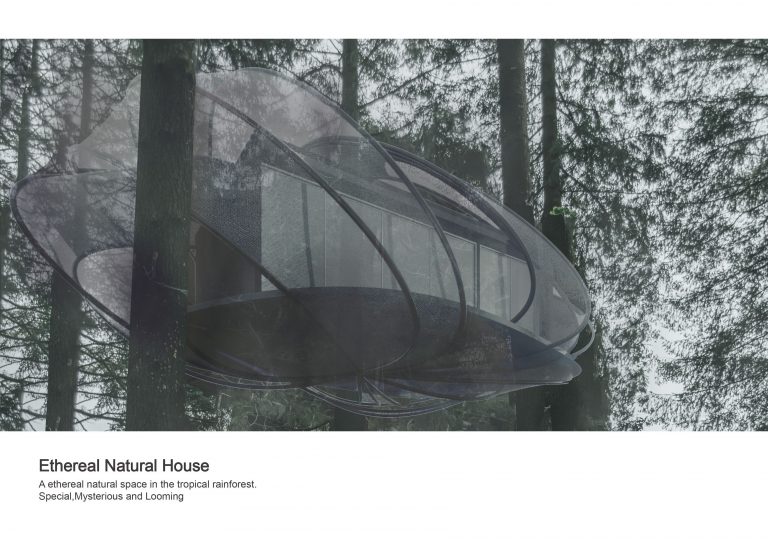
ETHEREAL NATURAL HOUSE

Chun-Wei Yang, Yeh-Ju Weng

Awards : United States
The Architecture Master Prize (AMP) 2021 / Architecture Design / Residential Architecture – Single Family · Winner

Design Issue In the natural environment, hard concrete buildings often become the destroyer of vision, so we thought about how to build a human living space in the vibrant tropical rainforest and integrate into it. Concept We followed the texture of the woods and looked for a suitable architectural concept. Finally, we decided to follow the appearance of the base in the form of a ribbon, and shuttle between the gaps of the woods in the form of neuron transmission.

閱讀全文
NSTC 國科會 Parametric design Project Robotics

Integrated Application and Development of a Robotic Parametric Control and Microcontroller-Based Rebar Bending Simulation Teaching Machine

With the arrival of the Fourth Industrial Revolution, countless technological and digital fields are progressing rapidly, including the architectural industry. The international rise of BIM (Building Information Modeling) and digital architecture, through systematic material management and parametric form design, has become the most sought-after development direction in the fields of architecture and construction in recent years. The greatest characteristic of digital and parametric design lies in its reliance on precise calculations. The main structures of traditional buildings are mostly vertical and horizontal beam-column systems, whereas parametric design must perform specialized shaping of structural materials according to different designs. Currently, the pre-bending rebar machines used are all limited to single-axis bending, resulting in insufficient degrees of freedom regarding rebar bending orientation and final product shape, and cannot be perfectly applied to buildings with special shapes and structures. Therefore, how to make rebar products possess high degrees of transformational freedom and comply with fully automated production has become a common challenge across the interdisciplinary fields of construction, BIM, and architectural design. This research will combine a microcomputer-controlled conveyor platform with the high-mobility freedom of a robotic arm to design a new form of rebar bending process for future parametric architecture. Based on the operational logic of current pre-bending rebar machines, it uses the robotic arm to break through the limitations of original dimensions, creating an automated production system emphasizing uniqueness and non-modularization that can be applied to future digital architecture, public artworks, etc.

The Fourth Industrial Revolution has brought rapid progress to technological and digital fields. BIM architecture performs specialized shaping in response to different structures through systematic management and parametric design. To solve the current dilemma of single-axis bending faced by pre-bending rebar machines, this project seeks to perfect the design and fabrication of buildings with special shapes and structures. This research combines a microcomputer-controlled conveyor platform with the high-mobility freedom of a robotic arm to simulate and design a new form of rebar bending process for the future, using the robotic arm to break through original dimensional limitations and emphasizing an automated production system that is unique and non-modular.

Through this special research project, the robotic arm is combined with an automated wire conveyor platform to create more diverse simulations of rebar bending processes. Due to environmental limitations, this project currently uses iron wire to simulate the integrated operation of the automated material conveyor platform and the robotic arm. However, in future developments, the application of actual large-scale rebar and building materials can allow the automated material conveyor platform to reduce the labor costs consumed in current rebar handling processes and be practically applied to digital architectural design, producing the required unique forms of rebar with the highest precision, significantly reducing material waste and the occurrence of excessive error values.

As this technical research and implementation become more mature in the future, it can be applied to industries related to architectural structures, such as the design and production of public artworks or large-scale industrial designs. The operation process will be like handcrafted art, processing materials in a more intuitive way to complete design works.

The design of the automated material conveyor platform has currently been developed using the Arduino Uno board. This model of chipboard belongs to the entry-level category. It is expected that during future development and through more in-depth exploration and research, higher-end chipboards will be used to improve the machine design, allowing for a better experience in both operation and handling.

閱讀全文
NSTC 國科會 Parametric design Project Robotics Tectonic Becoming

Data Translation and Representation in Art: A Case Study of Taiwan’s Declining Birthrate Issue

In this era of information explosion, our technological progress and success are unquestionable; yet, we have gradually overlooked a fundamental factor that influences a nation’s growth: the birthrate.

While countries pursue constant advancement, this issue is increasingly neglected. However, national growth is intrinsically linked to fertility. A declining birthrate signifies a gradual decrease in national productivity. Although the effects may not be immediate, the consequences of a low birthrate inevitably surface over time.

While many countries have begun to prioritize this issue, the public response to government policies has fallen far short of expectations. Many still believe that the declining birthrate does not pose a significant crisis, responding with indifference and causing government initiatives to falter.

If these outcomes could be directly experienced through art, it might foster a deeper understanding of the consequences of a declining birthrate.

Such an experience would allow viewers to see which events lead to specific results and anticipate future changes, potentially providing a warning effect that heightens public awareness of the crisis.

The objective is to utilize artistic space as a means to remind the public of, and provoke reflection on, the importance of this critical contemporary issue.

By arranging data within a white exhibition space, the information merges with the environment, allowing viewers to become fully immersed. Data with minimal variation is placed toward the back to optimize the visual effect, while a pillar representing Taiwan is positioned at the very front to draw visitors into the space.

Once data is transformed into an artwork and shaped into a space, it ceases to be a collection of indifferent figures on paper or screens; it becomes a tangible object for human experience. Compared to intangible data, physical data deepens the viewer’s perception and contemplation. Walking into a “forest of data” allows one to truly experience the reality of data surrounding them, as the data directly dictates the spatial effects.

If current birthrates were the same as those in the past, the viewer’s spatial experience would be akin to entering a healthy forest, where every pillar appears solid and stable.

However, the spatial experience reflected by modern society is fragile and unstable. This experience is used to remind the public that our current state is precarious and tottering.

Compared to mere paintings or graphic representations, the physicalization and transformation of data leave a more profound impression. Space is a state that can be felt directly through the senses, whereas charts often fail to convey the urgency of a situation.

This is the reason for three-dimensionalizing the data. Compared to visual changes alone, the direct experience of space—whether oppressive or spacious, stable or fragile—is more profound, as these are qualities understood through spatial perception.

Relying on such intuitive realization to contemplate abstract future events strengthens a person’s connection to and recognition of the issue. By using different scales of spatial forms, viewers can experience the gravity of the situation directly, moving beyond the limitations of two-dimensional charts.
閱讀全文